

























For most of the season, the Astros would have happily accepted the problem they have now.
After months of injuries, inconsistency, and a revolving door of starting pitchers, Houston’s rotation has suddenly become one of the biggest reasons the team is winning. Astros starters have posted a 2.05 ERA over the last 10 games, a stretch in which Houston has gone 7-3 and built a three-game lead in the AL West with 19 games remaining.
That is a remarkable turnaround for a rotation that entered Saturday with a 4.97 ERA, 28th in the majors, after the Astros were forced to use a franchise-record 18 different starting pitchers this season.
But pitching well and pitching deep into games are two different things.
Five Starters, Different Expectations
Hunter Brown, Hayden Wesneski, and Peter Lambert have emerged as the three starters Houston can reasonably expect to provide length.
Brown has gone 4-2 with a 2.68 ERA over his last eight starts. Wesneski has been excellent since returning from Tommy John surgery in late July, posting a 4-1 record and 3.18 ERA through seven starts. Lambert, who entered camp as a non-roster invitee, leads the club in wins, starts, and innings pitched.
Then there are Cristian Javier and Ethan Pecko.
Both have given the Astros encouraging outings, but neither is currently being used like a conventional starter.
Javier has faced no more than 19 hitters in any of his last four appearances, as Houston has been reluctant to let him work through a lineup for a third time. He has completed more than five innings just once in nine starts this season. Pecko has yet to complete six innings in a major-league start.
That effectively leaves the Astros with three starters expected to provide length and two whose outings may require considerably more from the bullpen.
Saturday Showed the Risk
Pecko wasn’t bad against Arizona on Saturday. Quite the opposite.
The rookie held the Diamondbacks to one run over 4⅓ innings, allowing five hits and one walk. Houston led 3-1 when his afternoon ended.
But removing a starter in the fifth inning means finding another 14 outs somewhere.
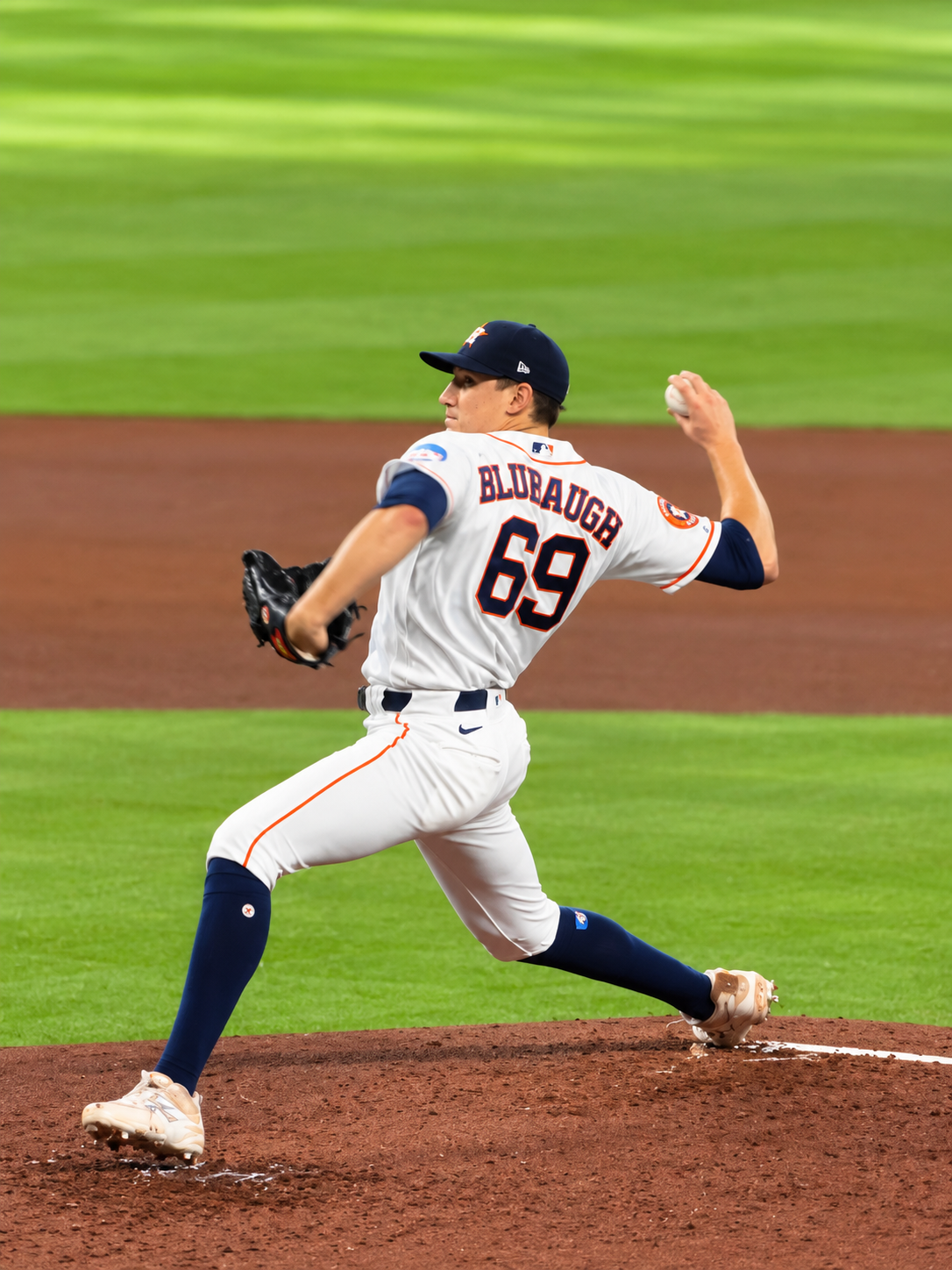
Enyel De Los Santos handled the first five. Then Kai-Wei Teng entered in the seventh and walked two of the three hitters he faced. That forced AJ Blubaugh into the inning earlier—and in a more difficult situation—than Houston would have preferred. Blubaugh escaped with the lead, but Ketel Marte homered off him in the eighth to tie the game.
Arizona eventually won 4-3 in 10 innings.
It was one game, and the loss certainly cannot be pinned on Pecko. The Astros also went scoreless after the fifth and squandered several opportunities to win it. But Saturday demonstrated the arithmetic Houston faces whenever a starter leaves early: even an effective outing can leave nearly half the game to the bullpen.
How Long Can the Bullpen Carry the Extra Innings?
That question matters because the bullpen isn’t operating at full strength.
Steven Okert is on the injured list with a hamstring injury, removing one of Houston’s most dependable relievers. Tatsuya Imai remains on the roster but has been used sparingly, while Ronel Blanco’s presence after his recent spot start further limits the number of traditional relief arms available to Joe Espada.
The schedule is about to provide some help. Sunday ends a stretch of 13 consecutive games, and Houston has an off-day on each of the final three Mondays of the regular season. The Astros won’t play more than six consecutive days the rest of the way, giving Espada considerably more flexibility to manage both his rotation and bullpen.
It also makes getting length from Brown, Wesneski, and Lambert especially important. Six or seven innings from one of them doesn’t merely help Houston win that night. It preserves the bullpen for the nights when Javier or Pecko may be finished after four or five.
There are encouraging signs that those restrictions could loosen. After Javier threw five innings of one-run, one-hit baseball Friday, Espada said the plan had been to get him through five innings and roughly 80 to 85 pitches, but indicated the Astros hope to extend him further going forward.
Pecko believes he has more to give, too. After Saturday’s start, he said he felt more comfortable in the strike zone and thought his pitch count left him capable of continuing. He also acknowledged the obvious: the decision isn’t his.
A Better Problem—But Still a Problem
Considering where the Astros were earlier this season, debating how Houston should manage five viable starters is practically luxurious.
The rotation fell apart almost immediately in April. Hunter Brown, Tatsuya Imai, and Javier landed on the injured list during the first road trip, while Imai and Mike Burrows—the two major offseason additions to the rotation—struggled when healthy. Houston cycled through starters from Triple-A simply to fill the openings.
Now, with three weeks remaining, the Astros finally appear to have something resembling a functional rotation at exactly the right time.
The Astros don’t need Javier and Pecko to suddenly become seven-inning workhorses. But another inning here and another inning there could make an enormous difference to a bullpen that will be asked to protect a division lead—and, Houston hopes, pitch deep into October.
For most of the season, the Astros couldn’t find enough healthy, effective starters to fill a rotation. Now they finally have five.
The next challenge is getting five innings to become six.
Heading to Daikin Park soon? Check our complete Astros promotions schedule before your next game.