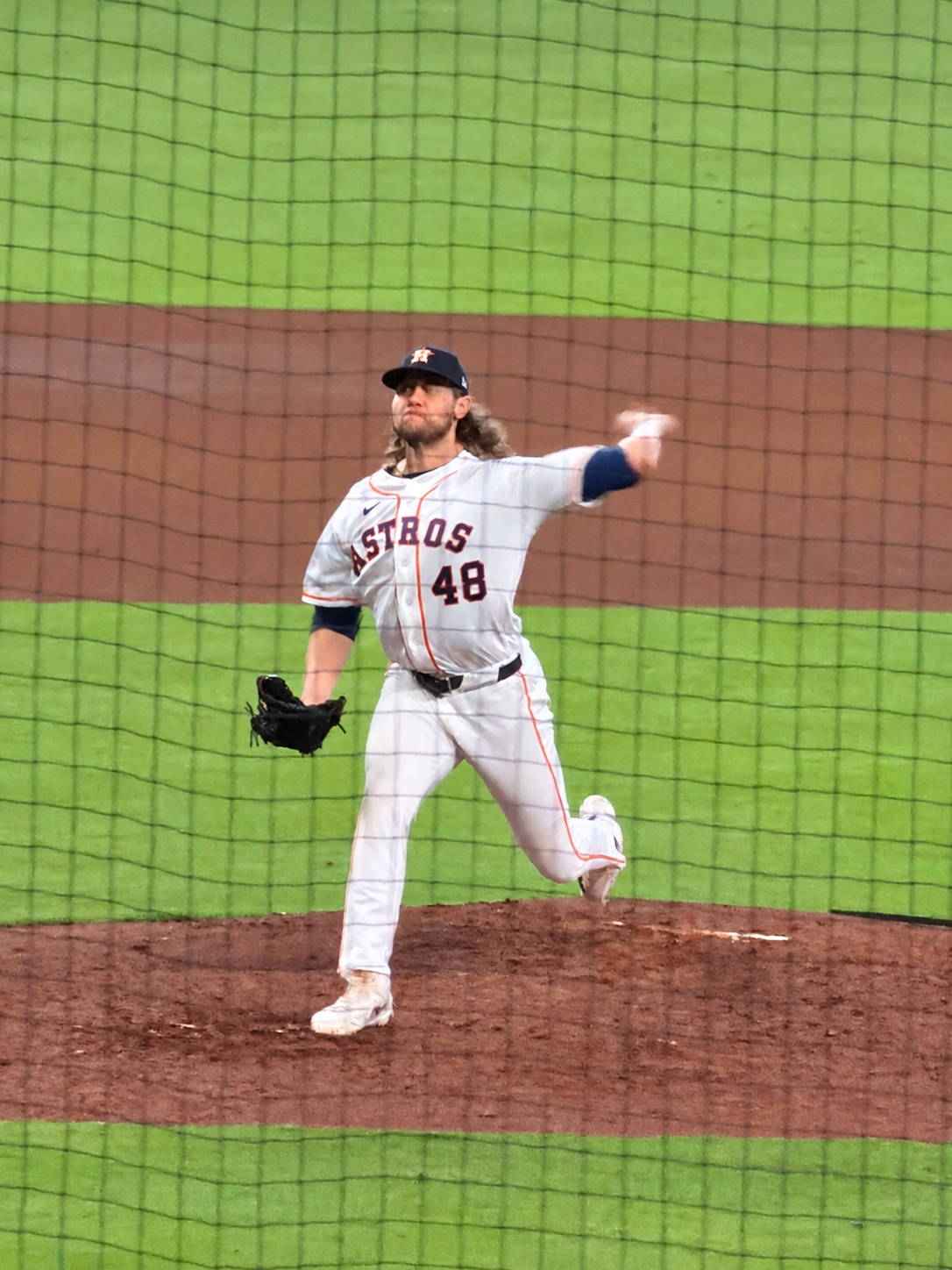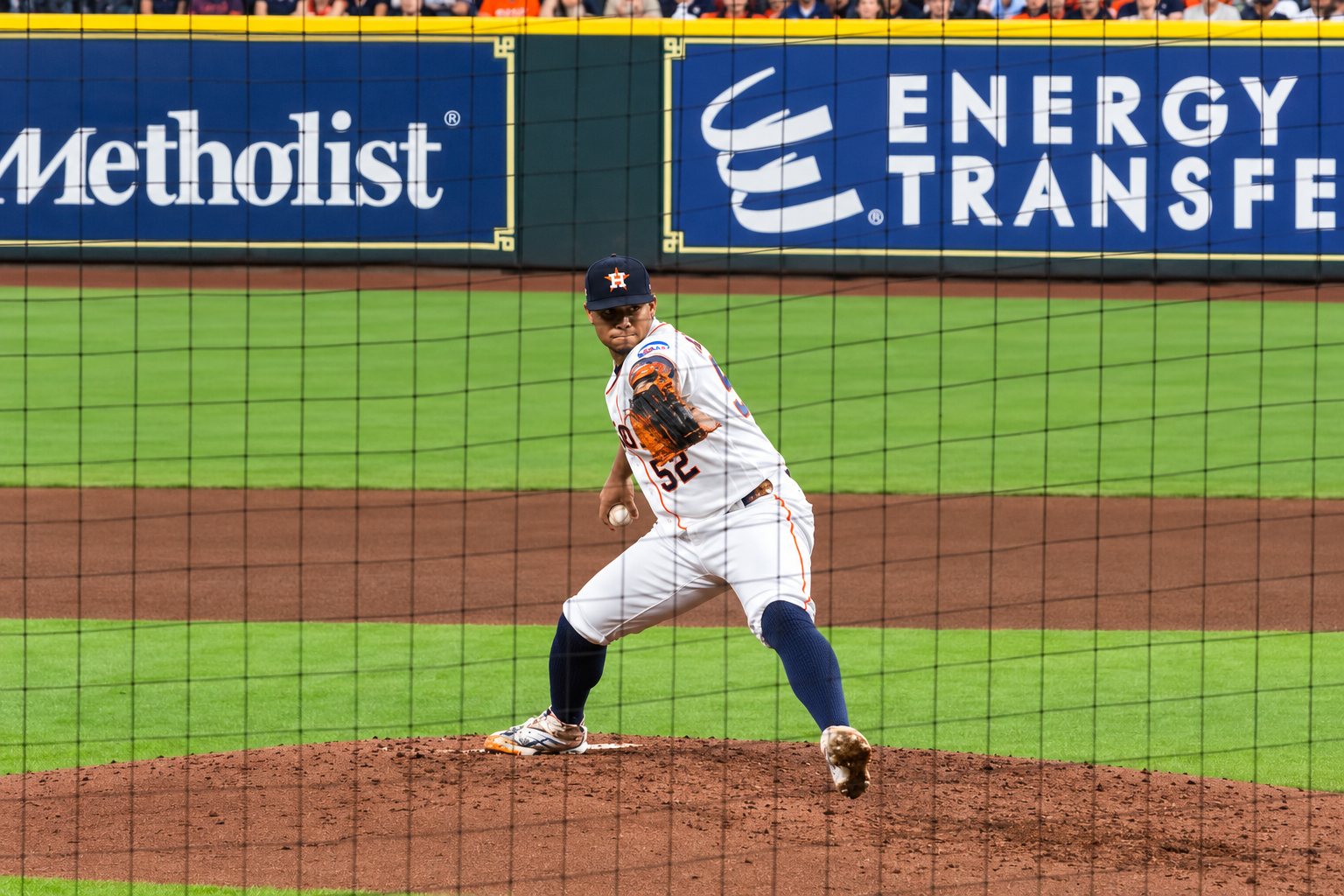

Bryan Abreu’s final appearance of 2026 was a painful one. His season as a whole was considerably more complicated.
The right-hander entered the sixth inning of the Astros’ 7-3 loss to the Chicago White Sox in Wild Card Game 2 with two runners aboard. Chase Meidroth hit his misplaced slider for a three-run home run, extending Chicago’s lead and helping end Houston’s season.
Only one of those runs was charged to Abreu, but the home run could prove to have been his final act with the only major-league organization he has known. Abreu elected free agency Thursday, leaving the Astros to decide whether his dramatic recovery outweighs the warning signs that appeared early in the season.
A Disastrous Beginning
Abreu’s season could hardly have started worse. He allowed 13 earned runs over his first 11 appearances, producing a 12.54 ERA in 9 1/3 innings.
The most troubling change was his diminished fastball. Abreu averaged 97.3 mph with his four-seamer in 2025, but that figure fell to 95.7 mph this season. The reduced velocity made it harder for him to overpower hitters and exposed the control problems that have followed him throughout his career.
Abreu walked 41 batters in 62 2/3 innings this season. His 5.9 walks per nine innings were his highest rate since 2021, and they frequently forced him to work from behind in counts.
The early results were so poor that Abreu lost his customary place near the back of the bullpen. The pitcher who had recorded at least 100 strikeouts in each of the previous three seasons no longer looked like an automatic choice for the Astros’ most important late-inning situations.
Abreu Rebuilt His Season
Abreu did not remain buried.
Over his final 55 regular-season appearances, he allowed 13 earned runs in 53 1/3 innings, good for a 2.19 ERA. He struck out 64 batters during that stretch and gradually worked his way back into higher-leverage assignments.
Houston also helped Abreu adjust to his diminished velocity. He introduced a cutter in June, giving hitters another hard pitch to consider instead of allowing them to sit on either his four-seamer or slider.
The cutter eventually accounted for 11.4 percent of his pitches. Abreu continued to rely primarily on his slider and four-seamer, throwing each approximately 44 percent of the time.
His slider still generated a 39 percent whiff rate and a 34.8 percent strikeout rate. Hitters batted only .170 against his four-seamer, demonstrating that the pitch remained effective despite its reduced velocity.
By the end of the regular season, Abreu had recorded nine saves and returned to a high-leverage role.
His complete season line—six wins, four losses, a 3.73 ERA, 80 strikeouts, and 41 walks in 62 2/3 innings—did not resemble his finest work. It also concealed how much better he pitched after his catastrophic start.
The Case for Bringing Him Back
Abreu’s history with Houston provides the clearest argument for a reunion.
He owns a 2.82 ERA with 528 strikeouts in 392 1/3 regular-season innings. His 383 relief appearances rank third in franchise history behind Dave Smith and Billy Wagner.
Abreu has also repeatedly delivered in October. He has a 2.49 postseason ERA with 42 strikeouts in 25 1/3 innings across 23 appearances. During Houston’s 2022 championship run, he struck out 19 batters while allowing no runs in 11 1/3 innings.
His 2025 season showed that his ceiling remained extremely high immediately before this year’s difficulties. Abreu finished that season with a 2.28 ERA and 105 strikeouts.
Houston also knows the pitcher, the person, and the adjustments that produced his second-half recovery. That familiarity carries value for a bullpen that already faces offseason uncertainty.
The Risks Are Real
Abreu will turn 30 before the beginning of next season, and the velocity decline cannot be dismissed. Relievers whose success depends heavily on overpowering hitters can deteriorate quickly once their fastballs begin losing life.
His walk rate presents another concern. Abreu has always issued more walks than the Astros would prefer, but his reduced velocity leaves him with less room to survive those free passes.
The Astros must therefore determine whether his early collapse represented a temporary mechanical problem or the beginning of a longer decline. His strong finish supports the former interpretation, while the velocity and control trends support the latter.
Cost will matter as well. Abreu’s track record should attract interest from teams seeking an experienced late-inning reliever, and Houston has other roster needs competing for its available payroll.
Houston’s Bullpen Is Not Settled
Josh Hader remains under contract, but the bullpen behind him requires work. The Astros cannot simply assume that every young or inexpensive reliever will develop into a dependable setup option.
Houston has reportedly acquired Evan Reifert, a right-hander with considerable strikeout ability and serious control concerns, but neither team has formally announced that transaction. Even if the deal becomes official, Reifert would represent a bullpen possibility rather than a proven replacement for Abreu.
Abreu’s recovery makes the decision more difficult than it appeared in April. Houston would not be paying for the pitcher who posted a 12.54 ERA through his first 11 appearances. It would be betting that the pitcher who produced a 2.19 ERA over his final 55 can sustain the adjustments that rescued his season.
That may be a worthwhile bet at the right price. It would become a dangerous one if the Astros pay for Abreu’s reputation while overlooking the signs that his margin for survival has narrowed.